I’m a postdoctoral scholar at Caltech, specializing in multiphysics problems involving turbulent flows and the development of numerical simulation methods.
Research
Accurate and well-conditioned immersed boundary methods
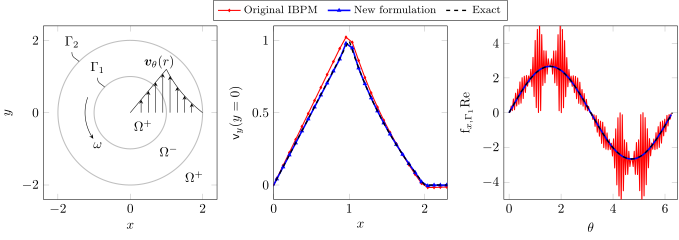
Immersed boundary methods let us simulate flows around complex, moving geometries on simple Cartesian grids, but classical continuous-forcing formulations are limited to first-order accuracy. I developed discretizations that achieve higher-order accuracy at the interface while improving the conditioning of the method within a projection-based framework, making the resulting systems cheaper to solve.
Fluid–metamaterial interaction in wall-bounded turbulence
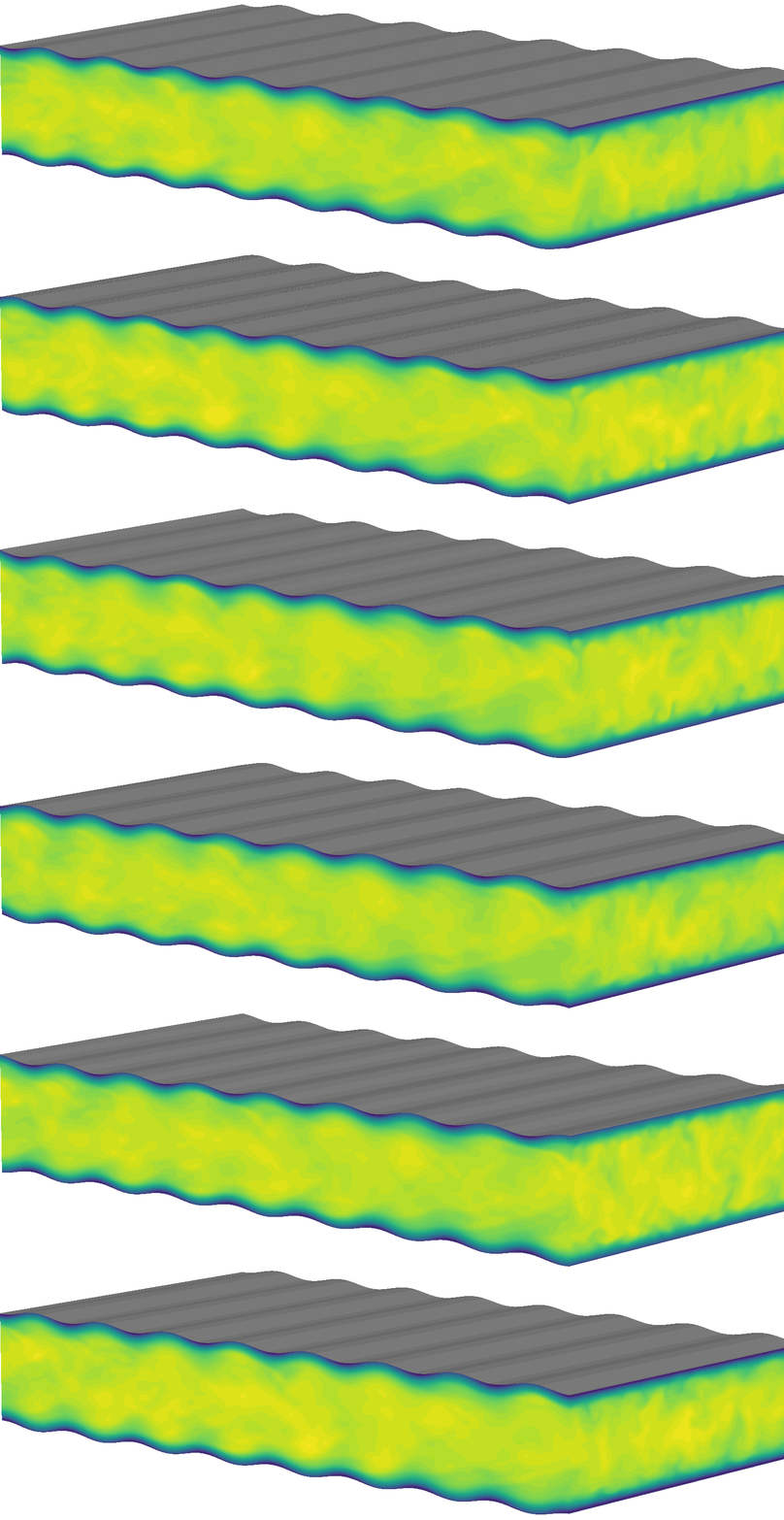
Metamaterial surfaces offer a route to passively manipulating wall-bounded turbulence, but simulating them means resolving a turbulent flow and a complex, moving subsurface structure at the same time. I integrated a strongly coupled fluid–structure interaction framework, built on a continuous-forcing immersed boundary method, into a parallel three-dimensional turbulent channel flow solver. New discrete operators pass information between subsurface metamaterial elements and compliant immersed boundary patches, while a hybrid uniform–stretched grid and parallelized immersed boundary operations keep the simulations affordable. The framework handles rigid, prescribed-moving, and compliant walls at \(\mathrm{Re}_\tau \approx 186\), laying the groundwork for simulations of true fluid–metamaterial interaction.
Basal melting and seawater intrusion in Antarctic grounding zones
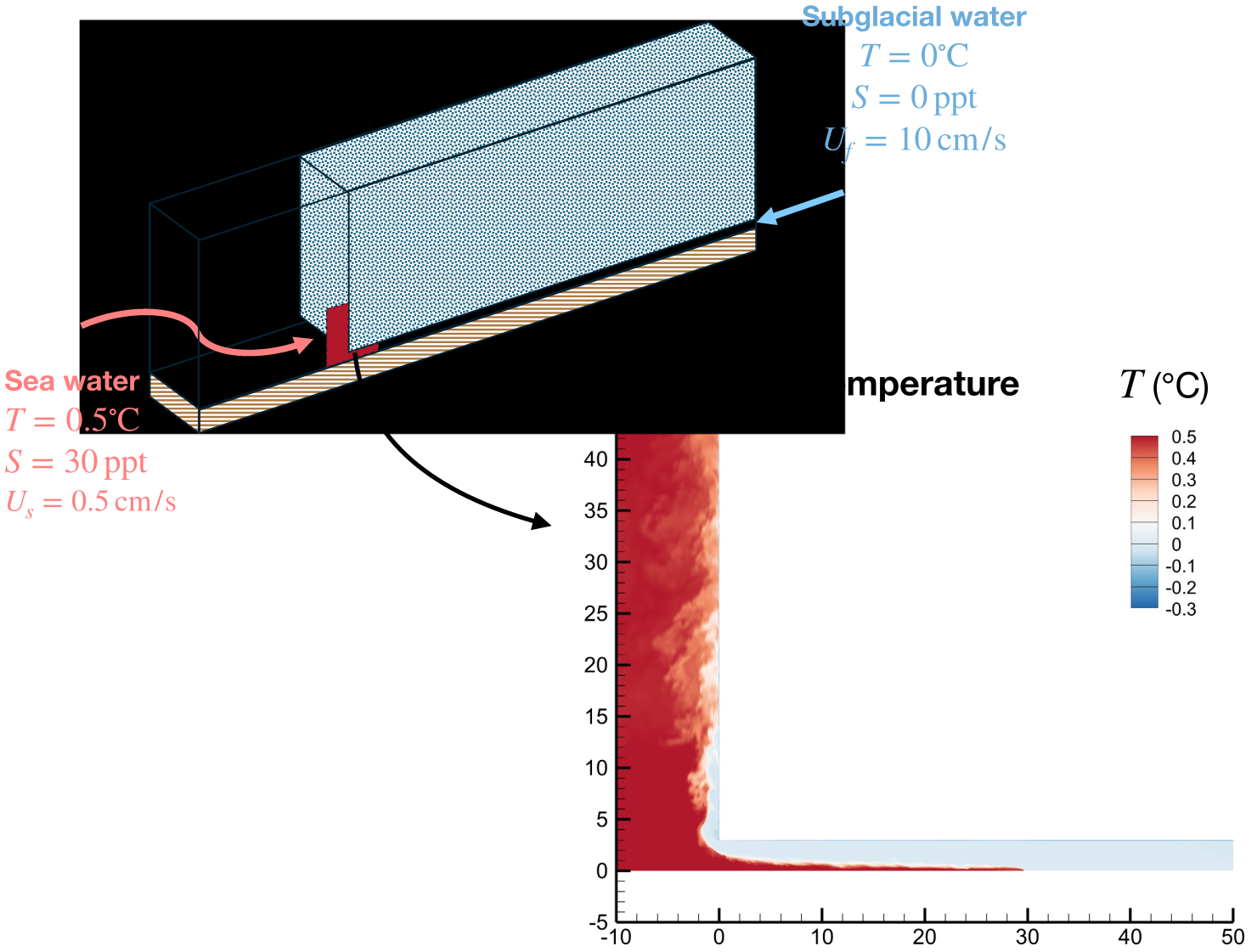
Basal melt rates under Antarctic ice shelves peak near the grounding zone, where warm, salty seawater intrudes into the channel beneath the ice. Ocean-cavity models work with kilometre-scale grid cells and cannot resolve that intrusion, so they fall back on melt-rate parameterizations, while the models built specifically for the intrusion are one- or two-dimensional and assume up front whether the flow is laminar or turbulent. Together with collaborators I simulate the grounding-zone channel in three dimensions with a melting boundary condition, determining the flow regime from the simulations instead of prescribing it, and systematically varying the meltwater inflow rate and the channel height.
Model-based reinforcement learning for flow control
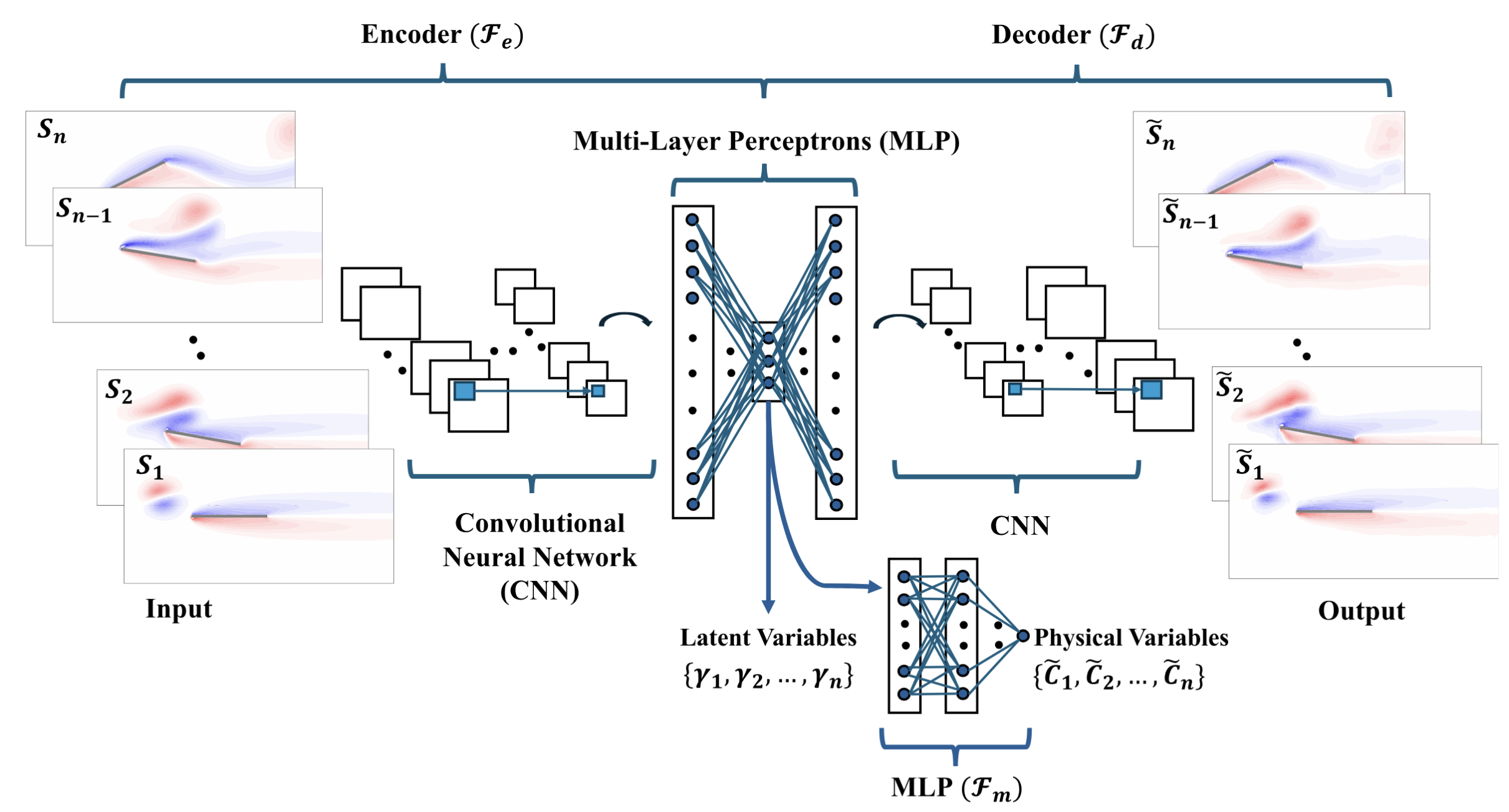
Model-free reinforcement learning needs an enormous number of interactions with the flow environment before it finds a workable policy, and when that environment is a CFD simulation the training cost becomes the bottleneck. This work — led by Zhecheng Liu at UCLA, with me as second author — replaces the full environment with a reduced-order surrogate: a physics-augmented autoencoder compresses flow snapshots into a three-dimensional latent space, and a latent dynamics model predicts how trajectories in that space respond to action sequences over long horizons. A policy trained entirely inside the surrogate transfers to the full CFD environment, where it mitigates the lift variation of an airfoil encountering gusts.
Flow control with reinforcement learning
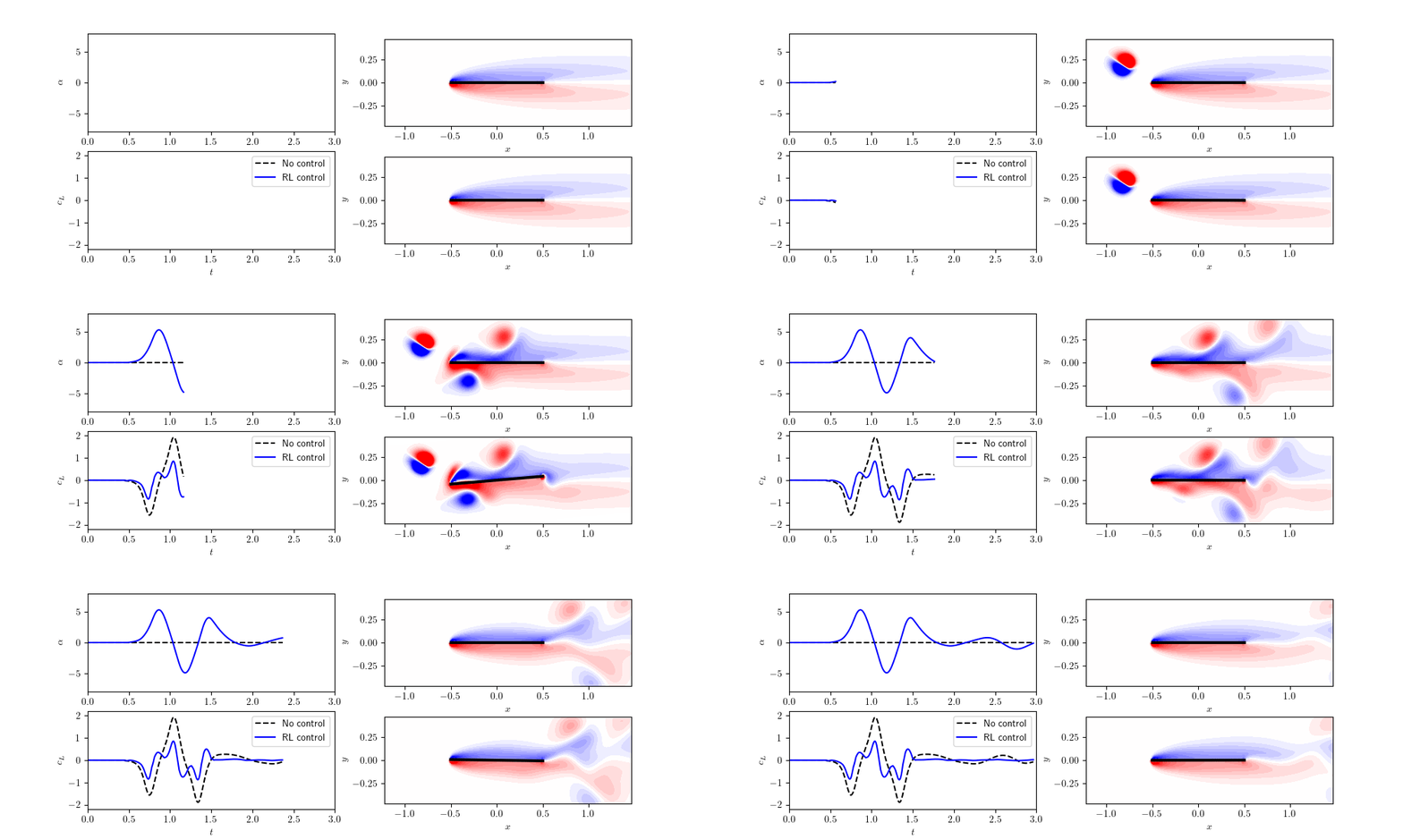
An airfoil flying through a strongly disturbed environment only ever sees a few noisy surface measurements, yet it has to react to gusts that have not reached it yet. I use deep reinforcement learning to find pitch control policies from such partial observations, and study how they generalize to unseen gust structures.
A computationally augmented wind tunnel
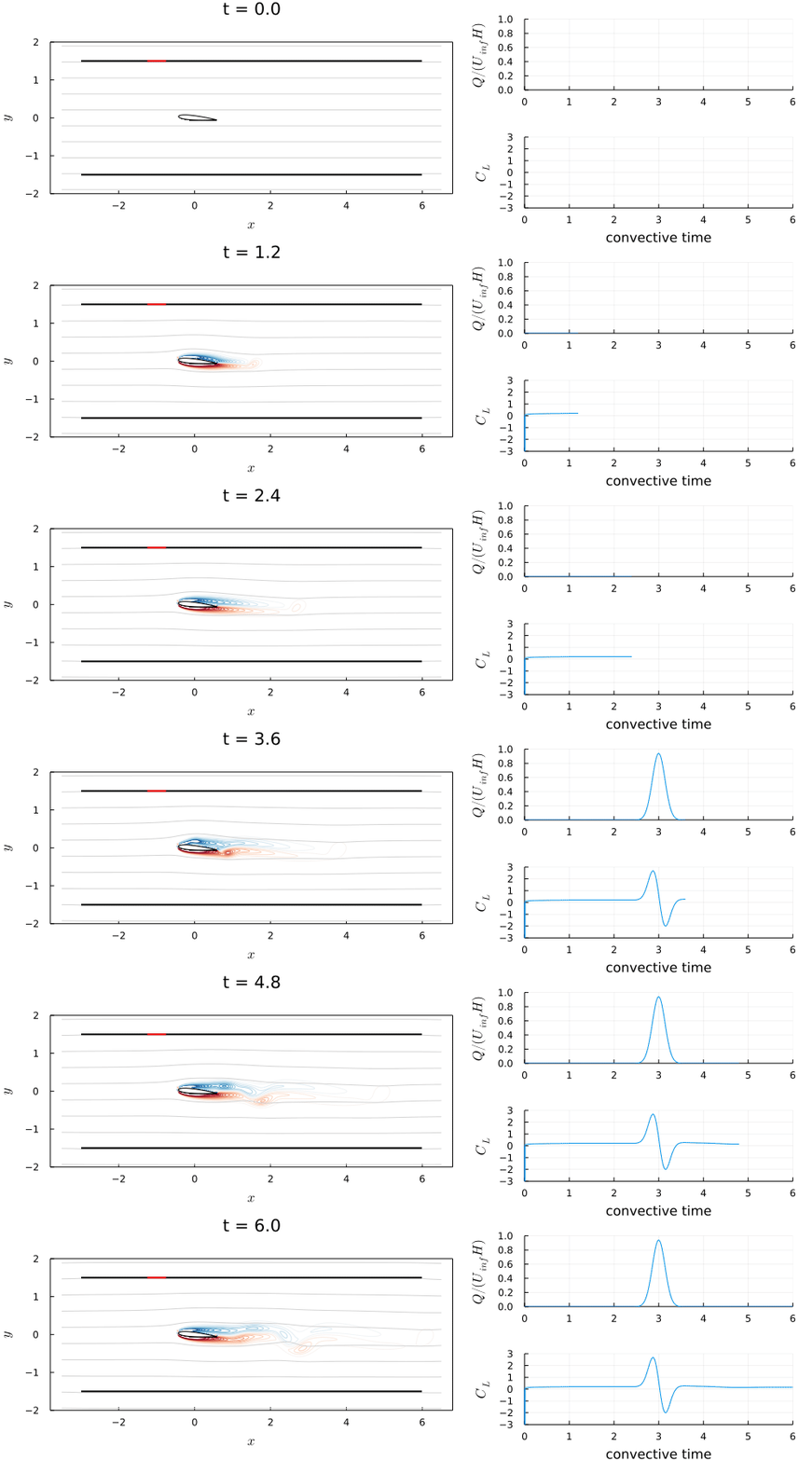
Gust-interaction experiments take place in a wind tunnel, but the simulations that accompany them usually leave the tunnel out: no walls, no gust generator, just an airfoil meeting an idealized gust in free space. I built a computational counterpart of the tunnel itself, in which the flow near the test subject is solved as a viscous, unbounded external flow, while the walls, the inlet flow rate and the gust generator enter through a separate potential flow that cancels the flow through the walls and introduces the gust as a distribution of sinks on the top wall. Superposing the two through a Helmholtz decomposition lets the viscous solver keep its compact lattice Green’s function domain around the vorticity, while the much smoother wall correction is solved on a coarse grid. Modeling a tunnel inspired by the Andrew Fejer Unsteady Wind Tunnel, I find that the walls barely matter for a weak gust at zero angle of attack, but that confinement and the concentrated suction become important at a higher angle of attack or gust strength — enough to separate the flow where the free-space model keeps it attached. Because the model is a digital twin of an actual tunnel, it can also be paired with experiments through data assimilation, which I demonstrate by inferring the gust strength from noisy synthetic velocity measurements.
Potential flow on Cartesian grids
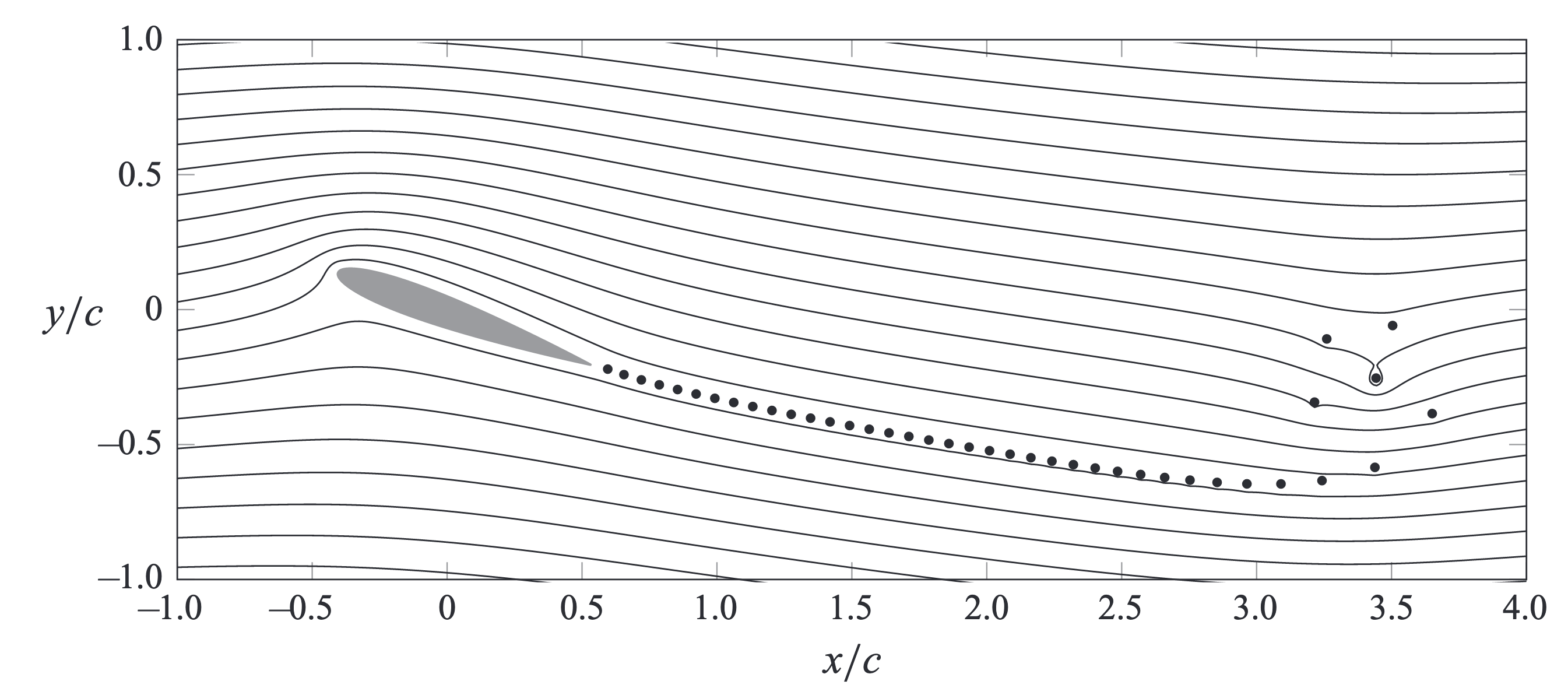
Low-order vortex models of unsteady aerodynamics spend most of their effort on Biot–Savart interactions between vortex elements, which scale poorly as the wake grows. I developed a grid-based alternative in two dimensions: the circulation is transferred onto a Cartesian grid and the streamfunction–vorticity Poisson equation is solved there with a lattice Green’s function, which satisfies unbounded boundary conditions without a large domain. Bodies of arbitrary shape enter through the immersed boundary projection method, whose Lagrange multiplier turns out to be the bound vortex sheet strength, and sharp edges are handled by splitting that sheet strength into a singular and a smooth part, so that enforcing the Kutta condition becomes a constraint on the smooth part. Sources and sinks follow the same route through the scalar potential, and the combined velocity field follows from a Helmholtz decomposition.
Augmented lifting line and lifting surface models
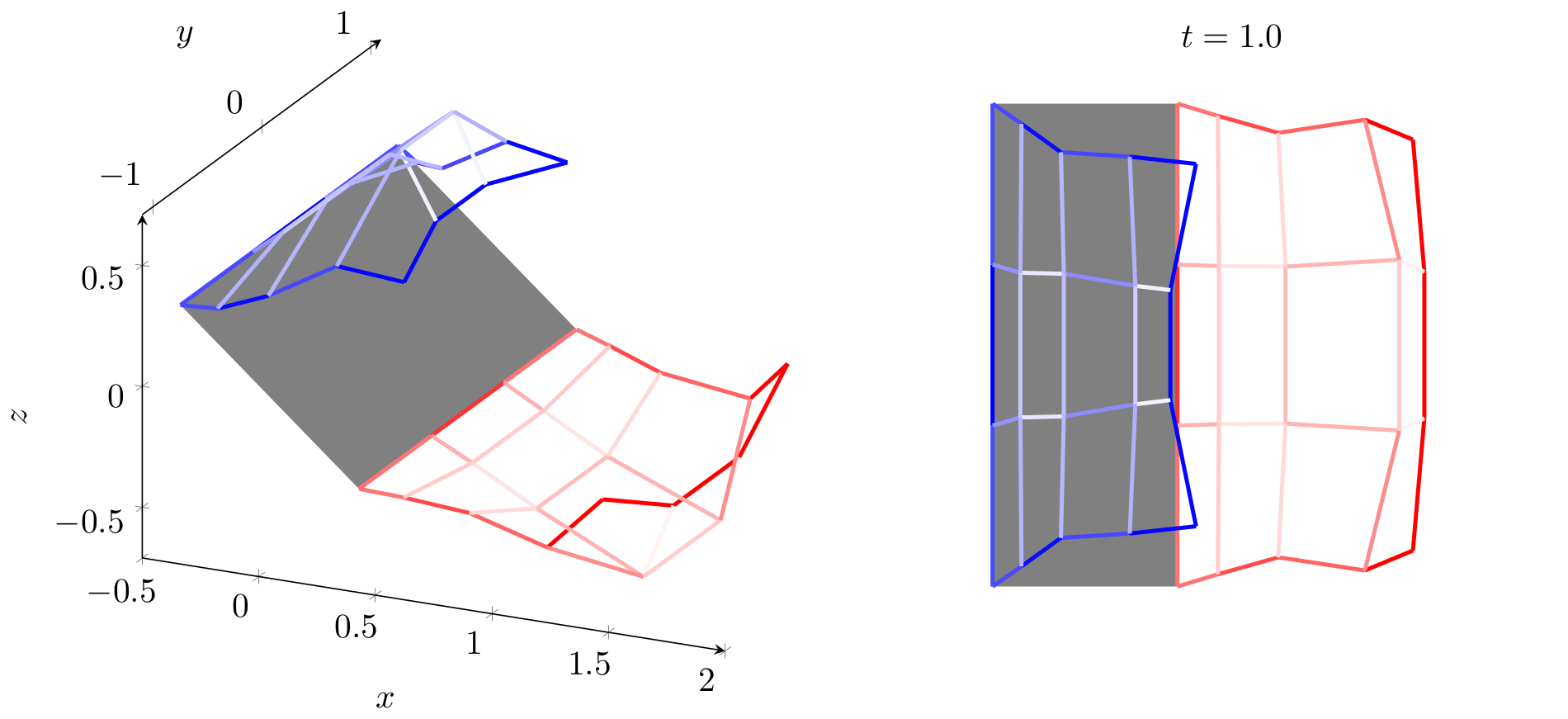
Two-dimensional vortex models capture unsteady aerodynamics cheaply, but a two-dimensional model is really an infinite wing: its bound vorticity extends forever in the span. A finite wing instead sheds its bound circulation into streamwise filaments towards the tips. I explored a middle ground between the two, in which two-dimensional vortex models sit at a set of spanwise stations and see a freestream corrected for the spanwise, streamwise and outer induced velocities, while the resulting filaments interact directly in three dimensions. Because an unsteady lifting line cannot represent three-dimensional effects on the leading-edge vortex, the same idea extends to a lifting surface, where the two-dimensional models only set the strengths of the surface and wake filaments and the system is advanced through direct filament interactions. This work is exploratory and unpublished: it still needs vortex aggregation to keep the model order low, a comparison of the predicted forces against truth data, and a test inside a flow estimation framework.
Cold-to-hot transformation for turbofan blades
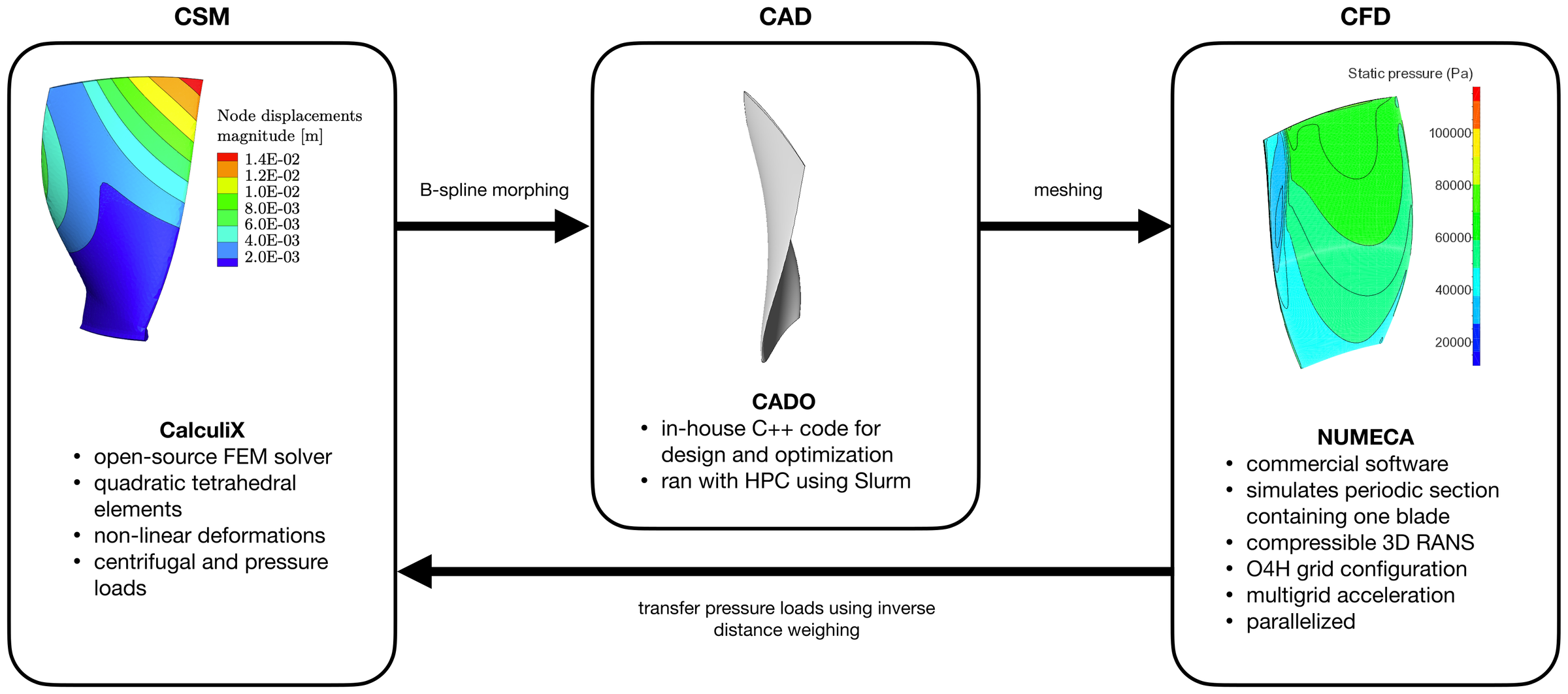
A turbofan blade is manufactured in its unloaded “cold” shape, but it flies in a “hot” shape: centrifugal and aerodynamic loads stretch it radially and untwist it by several degrees, which is enough to shift the fan’s operating point. During my master’s thesis, carried out at the von Karman Institute, I extended the existing cold-to-hot transformation — which accounted for centrifugal loads only — into a partitioned aeroelastic loop that also carries the aerodynamic pressure loads, iterating between a structural analysis, a morphed CAD geometry and a CFD analysis until the deformed blade settles. With it I quantified how untwist raises the mass flow rate and total bypass pressure ratio while lowering the isentropic efficiency, and ran a parametric study showing how lean, sweep, chord length and thickness each shift the untwist.